Example: discover candidate proteins
This example shows how to screen candidate proteins with a target function from metagenomic or public sequences, then narrow the validation set using sequence similarity, structural features, and property predictions.
Example summary
| Item | Content |
|---|---|
| Task type | Protein discovery and candidate screening |
| Subject | Novel proteins with a target catalytic function |
| Input | FASTA, metagenomic sequences, or a description of the target protein |
| Output | Candidate sequences, similarity, structure and property evidence, validation priorities |
Define screening criteria
Before submitting, be explicit about the target function, source scope, and exclusions:
- Target substrate or reaction type.
- Desired temperature, pH, salt, or solvent tolerance.
- Sequence length, domains, and key conserved sites.
- Whether to exclude known homologs, signal peptides, or transmembrane regions.
- Whether you need sequences, structural models, scores, or downloadable analysis files.
Prepare inputs
- Upload a FASTA file with unique sequence names; without a FASTA, describe the target in natural language and let the agent query public databases such as UniProt for sequences, annotations, or structures.
- State each sequence's source, species, sample ID, and version.
- Provide known positive templates, key sites, and expected screening thresholds.
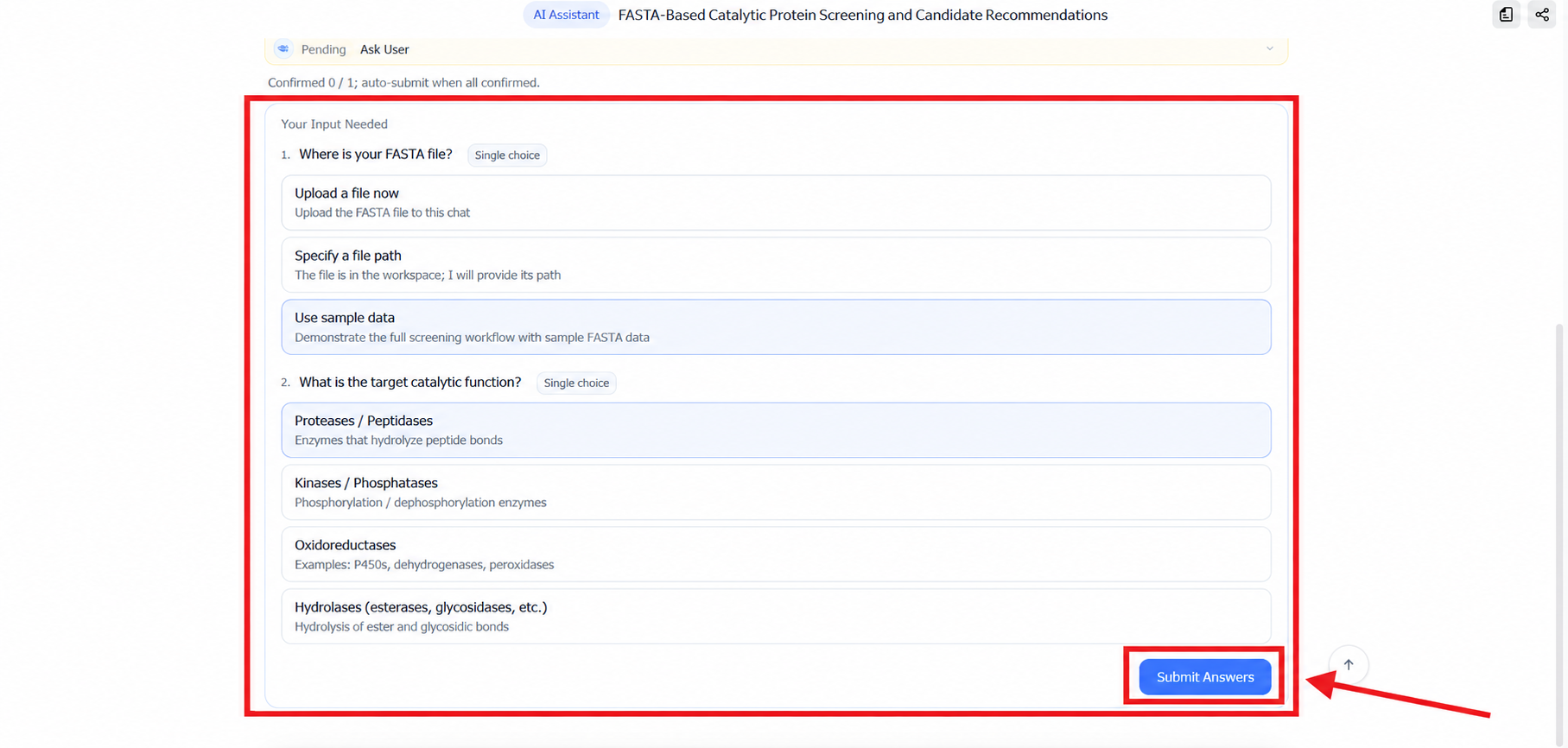
Question submitted
Screen the attached FASTA for proteins that may have the target catalytic function. First filter by sequence completeness, length, and key conserved sites, then rank by similarity, domains, subcellular localization, and property predictions. Return the top 10 candidates with sequence names, sources, main evidence, risks, and recommended validation order, keeping the screening thresholds auditable.
Analysis process
| Step | Tool or method | Purpose |
|---|---|---|
| 1 | Sequence quality and length filtering | Remove truncated, duplicated, and clearly incomplete sequences |
| 2 | Similarity and domain search | Determine family membership and functional conservation |
| 3 | Structure and property prediction | Assess folding, localization, solubility, and stability risks |
| 4 | Multi-criteria ranking | Build candidate priorities with stated trade-offs |
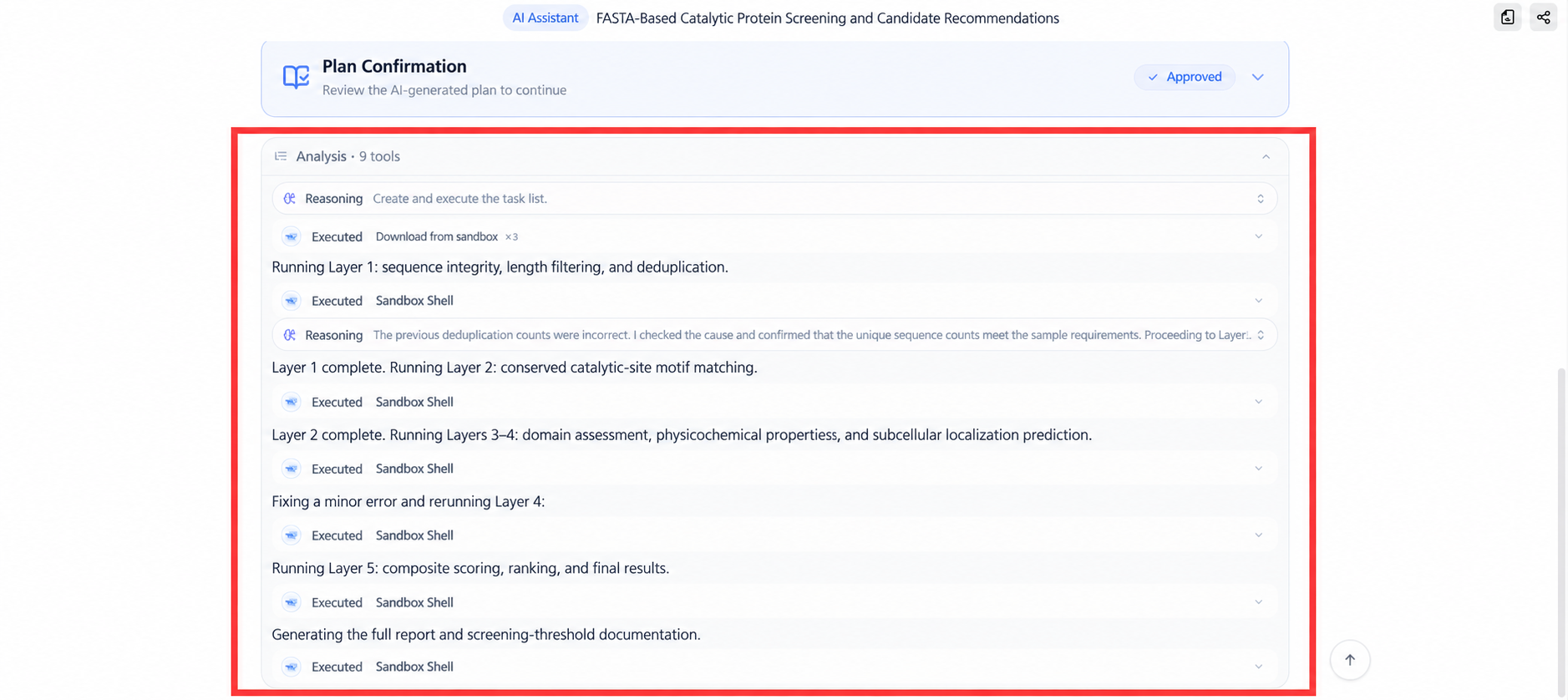
Candidate list
Candidates should include at least:
| Field | Use |
|---|---|
| Sequence name and source | Trace samples and database versions |
| Length and completeness | Exclude truncated or abnormal sequences |
| Family and domains | Judge fit with the target function |
| Key sites | Check catalytic, binding, or conserved residues |
| Predicted properties | Assess expression, solubility, and stability |
| Risks and advice | State open questions and priorities |
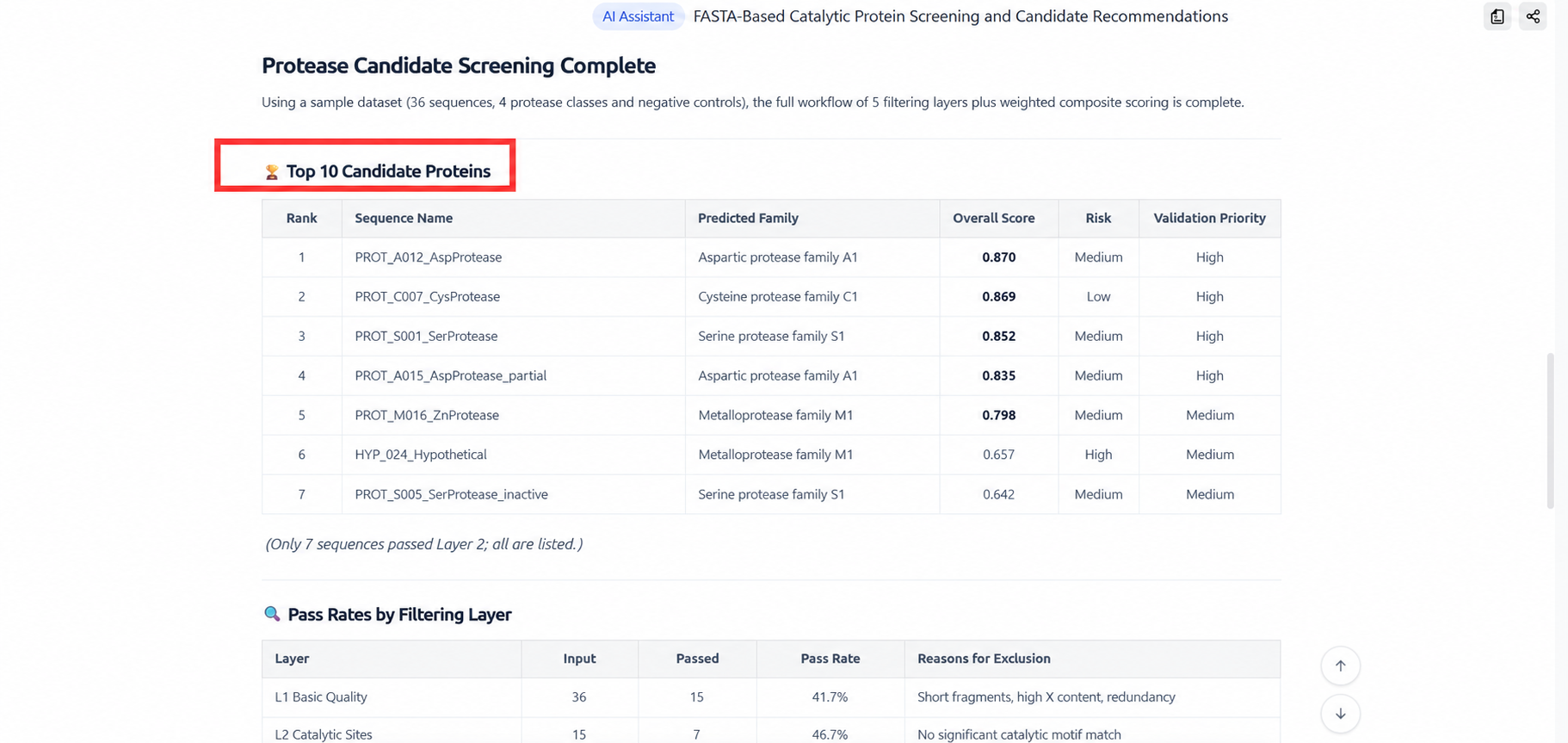
When a query returns many results, content may be paginated or truncated and exports may be limited. Narrow the query or process in batches, and treat the finally saved or exported candidate list as authoritative.
Narrow the validation set
Prefer candidates whose evidence is mutually supportive, sequences complete, and risks manageable. Sequences with a similar function but incomplete key sites should be flagged as exploratory and not ranked alongside high-confidence candidates.
Follow-up validation
- Before gene synthesis or cloning, re-check sequences, codons, and potential toxicity.
- Validate expression, solubility, and basic activity before comparing substrate range or stability.
- Keep input files, database versions, screening thresholds, and the candidate ranking.
Conclusions and boundaries
Candidate mining narrows the experimental scope. Sequence similarity, structure prediction, and property scores alone cannot prove a novel protein has the target function; the final conclusion requires expression, purification, and functional experiments.