Solutions
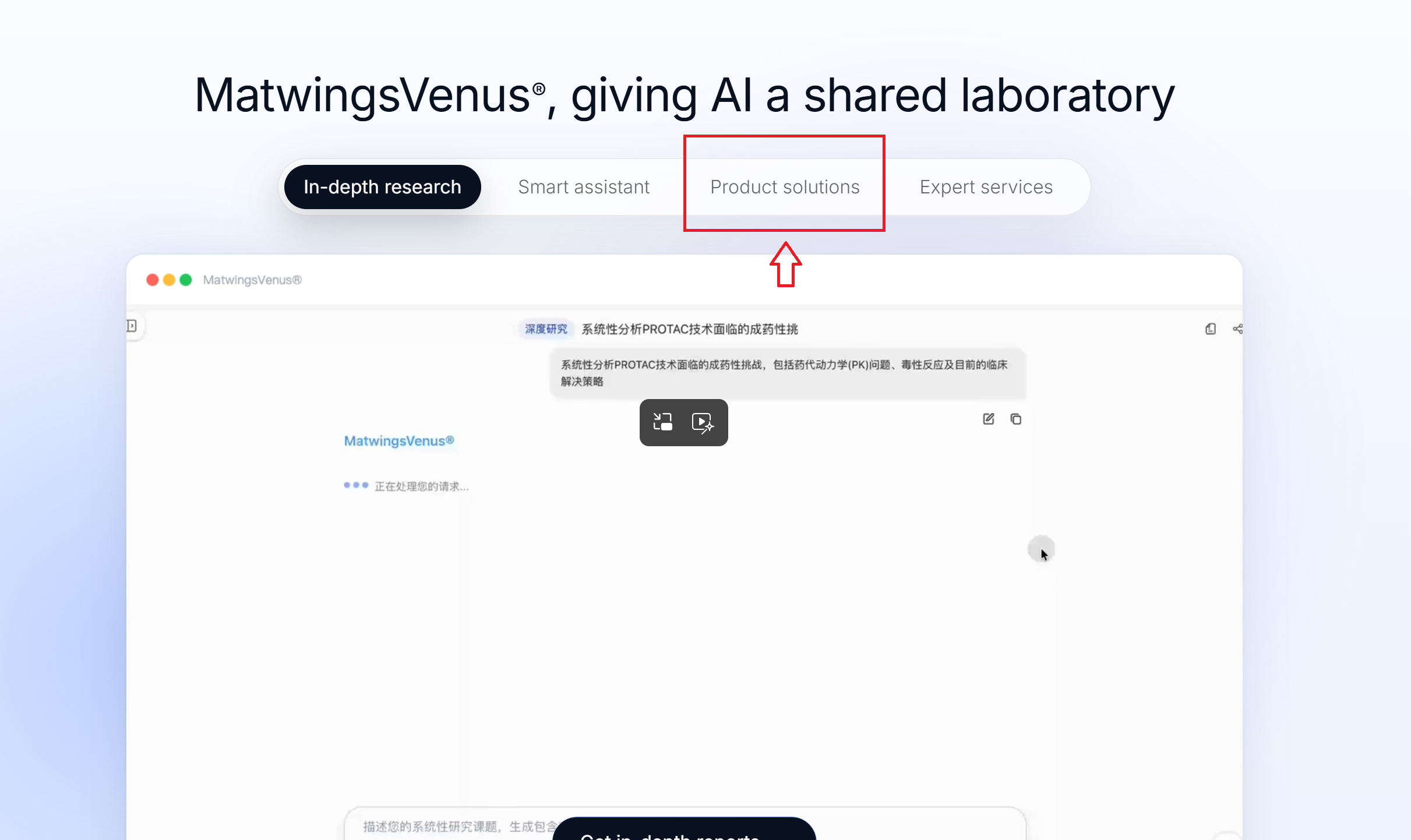
Solutions is the channel for combined, custom projects that standard products or single wet-lab services cannot fully cover—such as integrating protein design, experimental validation, production, models, or agent capabilities into one project. Submitting the form only starts the discussion; it does not fix a plan, price, timeline, or project start.
Scope
| Direction | Typical needs | Key preparation |
|---|---|---|
| Custom proteins | Standard products or services cannot meet the target function, performance, or application conditions | Target function, reference sequences, environment, indicators, validation methods |
| Custom production | Combining expression, purification, testing, and scale-up stages | Starting material, scale, quality requirements, delivery form, timing |
| Custom models | General models do not cover specific data, predictions, or R&D tasks | Task definition, available data, evaluation metrics, deployment constraints |
| Custom agents | Organizing knowledge, tools, and task steps around an R&D workflow | User roles, typical tasks, inputs/outputs, permissions, human checkpoints |
Prefer other entries when:
- A specific standard product exists: go to the product center.
- Only standard experiments such as gene synthesis, expression, purification, or antibodies are needed: go to wet-lab services.
- Only retrieval, analysis, or preliminary advice is needed: use the agent workbench.
- Mainly human judgment, plan review, or anomaly analysis: go to expert services.
Use Solutions to state a complete goal when the need combines several of design, experiments, production, models, or agents.
Open the custom requirement page
- Open the MatwingsVenus® home page.
- Find MatwingsVenus® Solutions.
- Select Get a solution.
- Under Contact us, open CRO service customization.
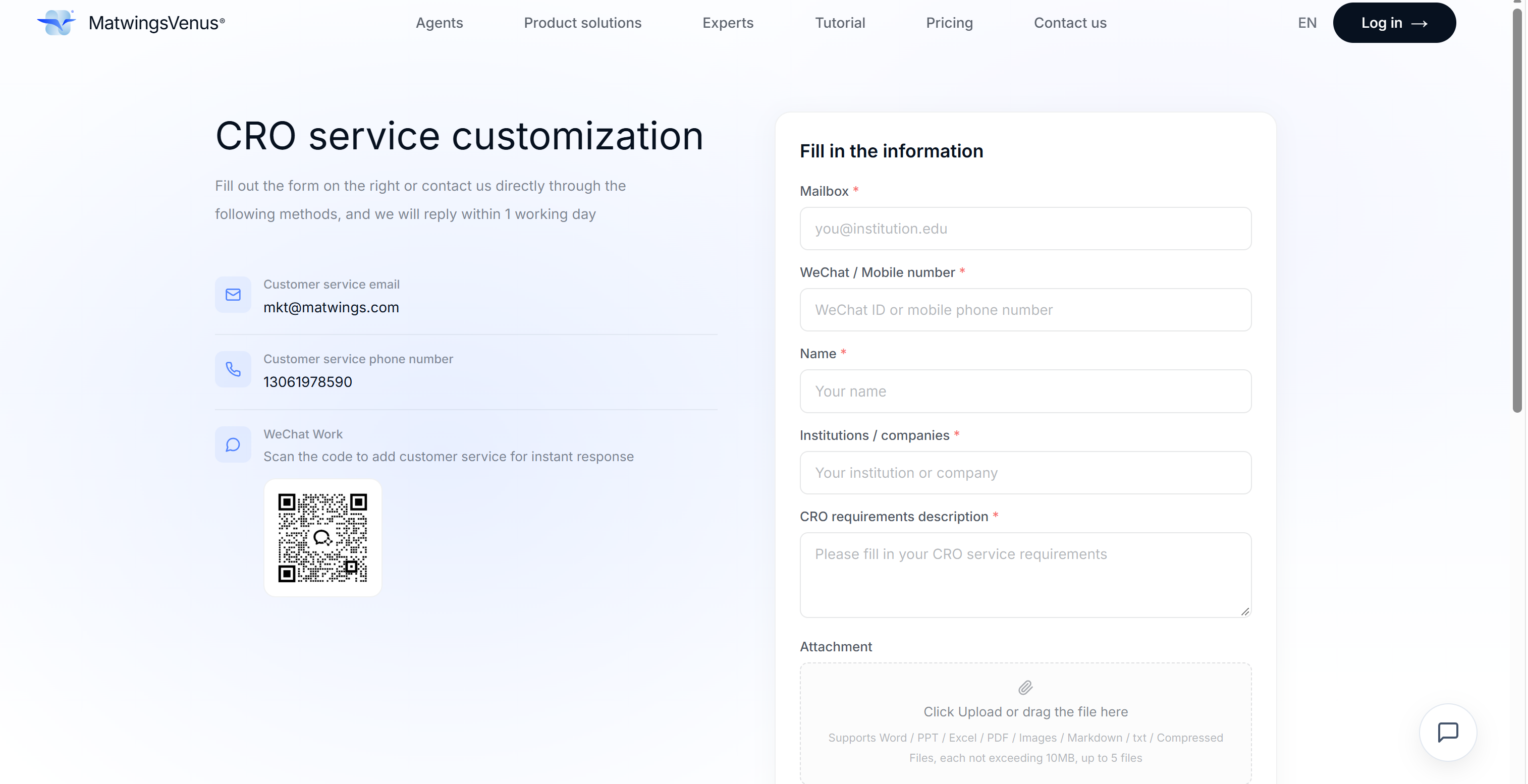
The form contains:
| Field | Required | Notes |
|---|---|---|
| Yes | A work mailbox able to receive project communication and material | |
| WeChat / Phone | Yes | An authorized project contact channel |
| Name | Yes | The actual project contact person |
| Organization / Company | Yes | The formal name |
| CRO requirement description | Yes | Background, goal, scope, deliverables, constraints |
| Attachments | Optional | Desensitized material that helps assess the need |
Response times shown are for initial contact only, not for plan assessment or project delivery.
Write the requirement description
Structure it as:
Background: subject, application scenario, current stage, main problem.
Goal: the result to design, optimize, validate, produce, or integrate.
Existing material: sequences, structures, data, samples, references you can provide.
Scope of work: design, analysis, experiments, production, or development the platform should take on.
Expected deliverables: candidates, samples, data, test results, models, software capabilities, or reports.
Indicators and constraints: test conditions, target ranges, timing, equipment, data, and compliance boundaries.
Open items: undecided questions needing technical assessment.
Distinguish three kinds of information:
- Confirmed: reliable information usable as current input.
- Target requirements: indicators hoped for but not yet validated.
- Open: items where the platform should help choose methods or assess.
Do not write only "custom protein needed" or "improve performance". State at least the subject, usage conditions, scope of work, deliverables, and acceptance criteria. Mark undecided parameters as open—do not fabricate them.
Attachments and data safety
The page currently supports Word, PPT, Excel, PDF, images, Markdown, TXT, and archives; each file up to 10 MB, at most 5 files. Actual limits follow the upload prompts.
Before uploading, check:
- File names identify content and version.
- Attachments agree with the goals, parameters, and identifiers in the description.
- You provide only the minimum material needed for assessment.
- Unrelated personal information, client names, internal notes, and old versions are removed.
- You hold upload rights and authority to let the platform use the files for this assessment.
- No passwords, API keys, access tokens, private keys, database credentials, or unauthorized data.
For sensitive sequences, raw data, or process files, start with public identifiers and desensitized summaries. Provide complete material only after the intake method, confidentiality scope, access rights, and purpose are settled.
Deliverables and acceptance
| Direction | Possible deliverables | Acceptance focus |
|---|---|---|
| Custom proteins | Candidate sequences, construction plans, samples, assay data, reports | Candidate count, functional indicators, test conditions, sample specs, document scope |
| Custom production | Samples, batch records, QC results, raw data, reports | Quantity, purity, concentration, activity, batch, storage and shipping |
| Custom models | Models, interfaces, evaluation reports, deployment and usage docs | Data splits, metrics, baselines, runtime environment, reproduction |
| Custom agents | Workflows, tool integrations, knowledge scope, permissions, docs | Typical tasks, inputs/outputs, human checkpoints, access boundaries |
Indicators must state test conditions. "Improve stability" should add temperature, duration, buffer system, assay method, and acceptable range. Exploratory projects should also define:
- The difference between target indicators and committed deliverables.
- Data, samples, and reports still delivered when targets are not met.
- Replication, controls, and review methods.
- Stage reviews, changes, pause, and termination conditions.
Target values are not automatic performance guarantees
Targets in the form support technical assessment. Whether they become acceptance commitments, how they are measured, and what happens if missed are settled in the formal plan and quote.
Submission and follow-up confirmation
Check the contact, organization, description, attachments, and privacy note before choosing Continue. Continue may enter a confirmation or real submission flow—do not click repeatedly, and do not read advancing as the project having started.
Before a project starts, confirm at least:
- Included and excluded work, and which side provides which inputs.
- Stages, milestones, communication cadence, and change handling.
- Deliverables per stage: format, test conditions, acceptance method.
- Timeline, fees, payment, invoicing, logistics, and extra costs.
- Sample storage, shipping, residual material, and waste handling.
- Rules for failure, rework, pause, termination, and scope changes.
- Data usage, ownership of results, IP, confidentiality, and disclosure.
Actual technical scope, price, timeline, and delivery terms follow the mutually confirmed plan. After assessment, if standard products or existing wet-lab services cover the need, the project may move to those entries.
FAQ
| Situation | Handling |
|---|---|
| Unsure whether to submit to Solutions | When standard products or a single service cover it, use the matching entry |
| Not sure how to write the need | Organize by background, goal, starting point, scope, deliverables, constraints, open items |
| No complete technical route | State known goals and boundaries; mark method choices as open |
| Attachment cannot be added | Check the current page limits: formats, 10 MB per file, at most 5 files |
| Material exceeds limits or is sensitive | Submit a desensitized summary first; confirm a secure transfer method |
| A confirmation step appears after Continue | Verify the information and the button meaning; do not click through |
| Requirements changed after submitting | Record the change, reason, and impact; confirm with your contact; do not resubmit |
| Disagreement over quote or timeline | Check scope, milestones, deliverables, and acceptance indicators item by item |