Example: design a protein engineering plan
This example shows how to design an engineering plan around activity, stability, or solubility goals and turn computational results into an actionable validation plan.
Example summary
| Item | Content |
|---|---|
| Task type | Protein engineering and candidate design |
| Subject | A target protein with known sequence or structure |
| Input | FASTA, PDB/mmCIF, known sites, and experimental conditions |
| Output | Candidate mutations, expected effects, risks, and validation order |
Task goal
Before submitting, state the property to improve, the function that must be preserved, and unacceptable risks. For example: improve thermal stability while retaining catalytic activity, or improve solubility without altering the substrate binding site.
Prepare inputs
- Provide versioned original sequences and structure files, or PDB IDs.
- Mark active sites, binding sites, conserved regions, and known harmful mutations.
- State the expression host, buffer, temperature, and evaluation metrics.
- Specify the candidate count, whether combinatorial mutations are allowed, and required file formats.
- This example relies on protein modeling/design skills; it may not complete with insufficient permissions or constrained resources. For large candidate sets, submit in batches or reduce the count, then wait for computation to finish.

Question submitted
Based on the attached sequence and structure, design mutation plans that improve thermal stability while keeping catalytic activity. First identify active sites, conserved regions, and likely structurally weak areas, then give no more than 10 single-point candidates and 3 combination plans. For each candidate, state the expected effect, structural rationale, potential impact on activity, and validation method, distinguishing computational inference from existing experimental evidence.
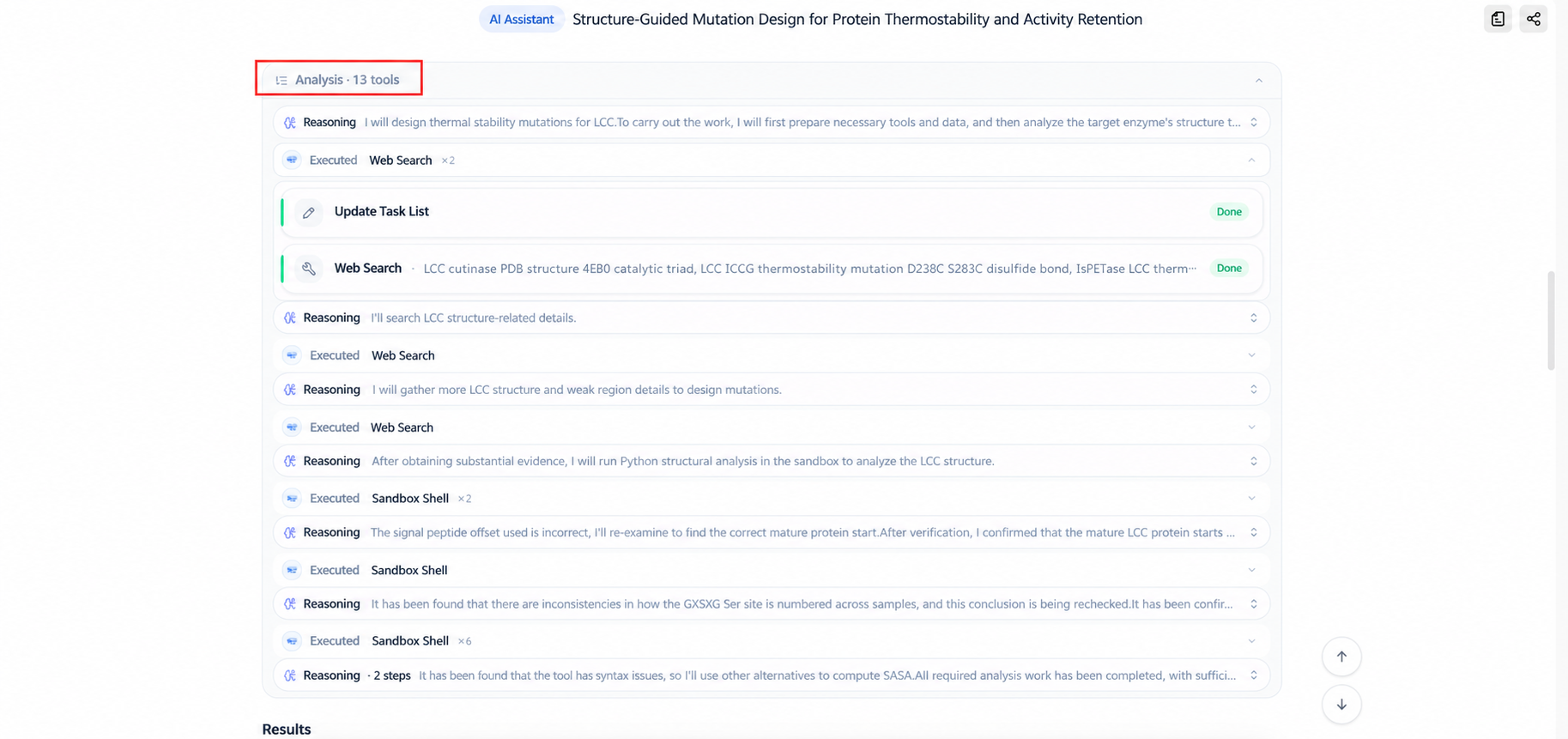
Analysis process
| Step | Tool or method | Purpose |
|---|---|---|
| 1 | Sequence and structure check | Confirm numbering, chains, missing regions, and model quality |
| 2 | Conservation and functional site analysis | Avoid changing key catalytic or binding residues |
| 3 | Stability and property prediction | Assess mutation effects on folding, interfaces, and solubility |
| 4 | Candidate ranking | Order by benefit, risk, and experimental feasibility |
Candidate plans
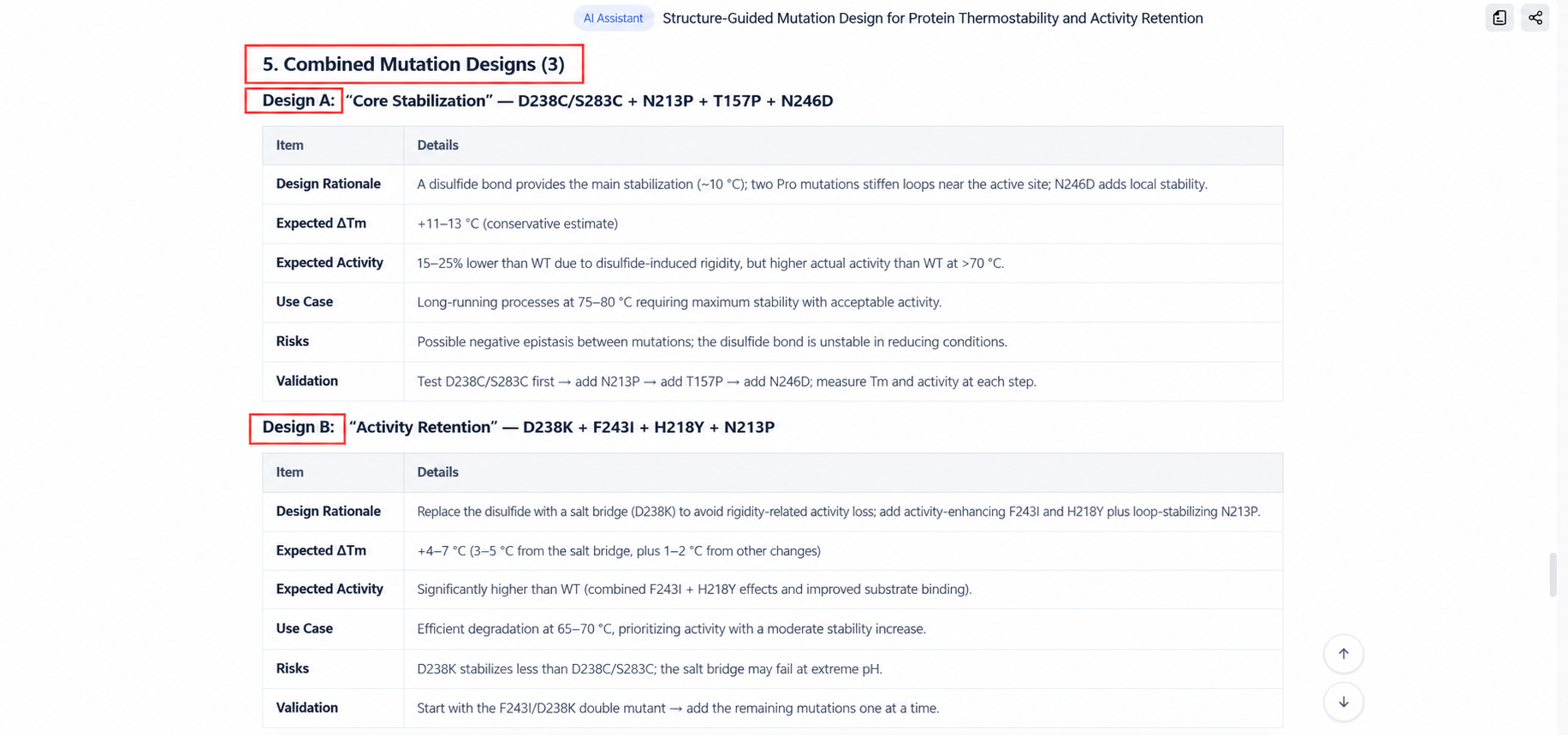
| Candidate | Mutations | Expected effect | Main basis | Risk |
|---|---|---|---|---|
| A | Single conserved substitution | Improve local packing or hydrogen-bond network | Structural proximity and stability scores | May affect activity |
| B | Surface polarity tuning | Improve solubility | Surface exposure and property prediction | May alter binding interface |
| C | Combination mutations | Stack multiple stabilizing effects | Single-point results and structural synergy | Epistasis and expression risk |
Manual review
- Confirm candidates do not change catalytic residues, substrate binding residues, or essential disulfides.
- Check whether mutation numbering refers to the full-length sequence or the mature chain.
- Stay cautious about predictions in low-confidence model regions.
- Among candidates of similar benefit, prefer the cheaper ones to synthesize and assay.
Validation plan
| Priority | Content | Suggested method | Metrics |
|---|---|---|---|
| 1 | Expression and solubility | Small-scale expression, supernatant assay | Soluble fraction, yield |
| 2 | Stability | Thermal shift or storage stability assay | Tm, half-life |
| 3 | Function retention | Substrate or binding assay | Activity, Km, affinity |
| 4 | Combination effect | Compare single and combined mutants | Synergy or antagonism |
Conclusions and boundaries
Engineering plans are computation-assisted candidate rankings, not experimental conclusions. Before formal adoption, complete expression, purification, stability, and functional validation, and record actual conditions and negative results.